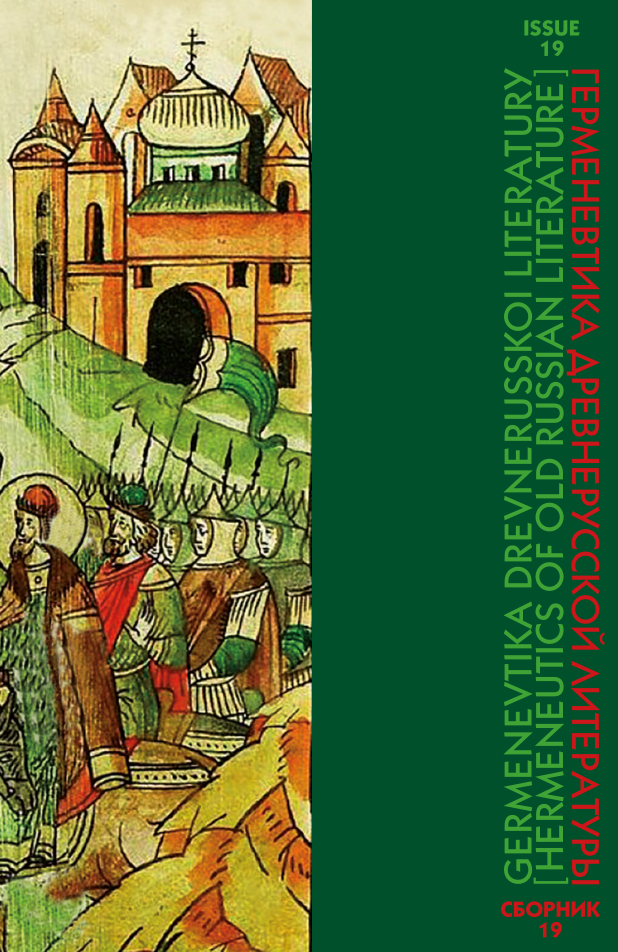
Hermeneutics of Old Russian Literature: Issue 25

Germenevtika drevnerusskoi literatury [Hermeneutics of Old Russian Literature]. Issue 25. Ed.-in-Chief O.A. Tufanova; sci. ed. M.V. Kaplun. Moscow, IWL RAS Publ., 2026. 768 p. (In Russian)
https://doi.org/10.22455/HORL.1607-6192-2026-25
ISBN 978-5-9208-0861-5

- Full text:
- Abstract:
The research included in this new edition covers a wide range of topics related to the artistic specificity of Old Russian literary works from the 11th to 17th centuries, problems of use and reception in 18th–19th century literature, the publication of newly discovered redactions, poetics, textual criticism, source studies, interpretation, and relationship between literary and historical-cultural contexts. The book reveals the characteristics of medieval artistic thinking, demonstrates hermeneutic methods for identifying hidden meanings, reconstructs the histories of the creation and use of works, and demonstrates how historical-cultural context influences the poetics and reading of works of various genres in the literature of Old Rus’. The materials are structured into sections and showcase both traditional and innovative approaches to the study of the literary heritage of Old Rus’. The book is primarily addressed to prepared readers — medievalists, university professors, graduate and undergraduate students in philology, historians, cultural studies, and art historians.
- Keywords: Old Russian literature, poetics, textual criticism, source study, edition, Old Russian art, reception
- EDN:
- DOI: https://doi.org/10.22455/HORL.1607-6192-2026-25
|
CODICOLOGY. TEXTOLOGY. EDITION |
||
| Vladimir M. Kirillin |
The Word for Antipascha by Cyril of Turov: Literary Dependence or Creative Independence |
|
| Dalmat (Yudin), hieromonk | ||
| Evgeny G. Malyuta |
Nature and Functions of Hymnographic Interpolations in the Messages of Prince Simeon Shakhovskoy Appendix. The Same Epistle from His Tsarist Majesty to the Boyar Prince Ivan Borisovich Cherkassky on the Certain Questions Asked of Him, the Story of Which is Clearly Presented Here |
|
| Alexandra V. Dukhanina | The Tale of Stephen of Perm: Sources and Manuscript Tradition | |
| Svetlana A. Semiachko | On the History of One Borrowing | |
| Yi Zhong |
On the Textology of The History of the First Patriarch Job of Moscow and All Russia |
|
| Anna B. Belova |
Appendix. A Set of Articles On the Composition of Ink and On Cinnabar Dissolution |
|
| Vladislav I. Petrushko | ||
| Marina A. Fedotova | On the Reception of the Chetii Minei (Menaion Reader) by Dimitry of Rostov: to Problem Statement | |
|
POETICS OF OLD RUSSIAN LITERATURE |
||
| Mikhail V. Pervushin | ||
| Nina V. Trofimova |
The Homily by Vladimir Monomakh and the Obituary Praise for Prince in the Laurentievskaia Chronicle |
|
| Alexey A. Pautkin | ||
| Ekaterina A. Andreeva |
“Like Locusts”: the Horde in the Novgorod First Chronicle of 6746 |
|
| Olga A. Tufanova |
“The Great Troubles in Moscow” of 1648: Depictions of Rebels in Old Russian Literary Monuments |
|
| Tatiana G. Popova | ||
| Andrey M. Ranchin | ||
|
PROBLEMS OF THE INTERPRETING OLD RUSSIAN LITERATURE MONUMENTS |
||
| Valery V. Lepakhin | ||
| Ani Petrs-Bartsumian | ||
| Irina G. Ponomareva | ||
|
Lyudmila G. Dorofeeva, Nikolai A. Nikonov |
||
| Svetlana K. Sevastyanova | ||
|
HISTORY AND OLD RUSSIAN BOOKLORE |
||
| Anastasia A. Preobrazhenskaya | ||
| Alexander A. Kazakov | ||
| Nikita V. Belov | ||
|
ARTS AND BOOKLORE |
||
| Liudmila B. Sukina | ||
| Marianna V. Kaplun | ||
|
MEDIEVIAN STUDIES AND LITERATURE OF THE MODERN TIME |
||
| Artem E. Trofimov | ||
| Valentina A. Melnichuk |
Preface in the Siberian Chronicle by Ivan Cherepanov: Author’s Concept of History |
|
| Mikhail Yu. Ljustrov |
The Epitaph of Ovid in Russian and Swedish Translations (17th–19th Centuries) |
|
| Symbols |